
Exploring the World of Technopolis Through Blogging
Roadmap IT
August 24, 2026
Comments (0)
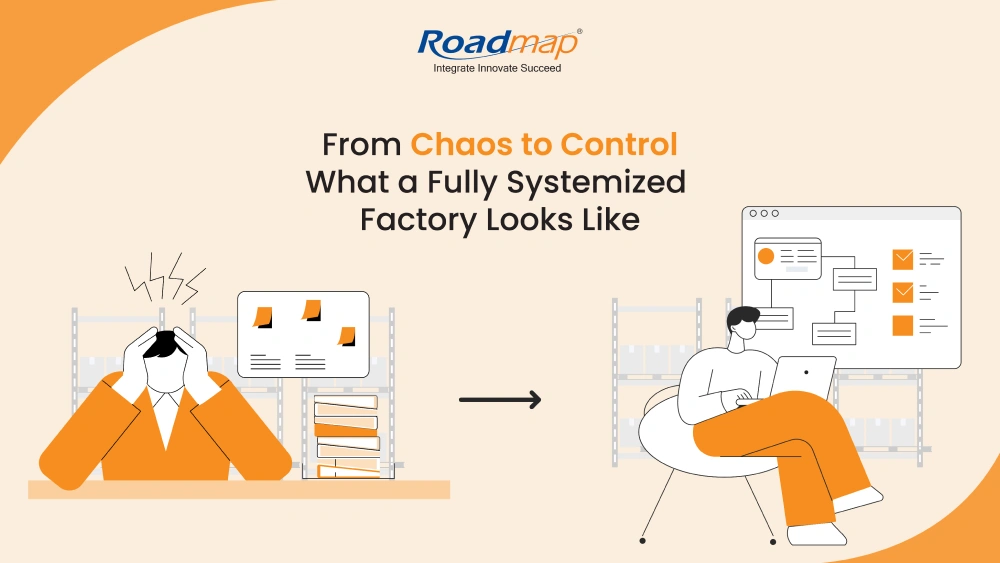
From Chaos to Control: What a Fully Systemized Factory Looks Like
1. The Factory That Looked Successful From the Outside
From the road, the factory looked impressive.
Trucks moved in and out.
Machines ran across two shifts.
The shop floor was full.
The order book was healthy.
Anyone visiting for the first time would have assumed the business was doing well.
And technically, it was.
But inside the factory, the day felt very different.
Production plans changed constantly.
Stores could not always confirm stock without checking physically.
Purchase received urgent requests almost every day.
Sales promised delivery dates before verifying capacity.
Finance waited for departments to submit information.
The owner remained involved in almost every important decision.
The factory was growing.
But the system running it had not grown with it.
This is where many Indian manufacturers find themselves.
The company has customers, machines, people and experience. Yet the business still depends on phone calls, memory, personal relationships and constant follow-up.
The factory produces goods.
But it does not produce predictable operations.
A fully systemized factory feels different.
Not because it has no problems.
But because problems become visible, ownership becomes clear and work continues without constant intervention from senior leadership.
2. What Does “Systemized” Actually Mean?
The word “system” is often misunderstood.
Some people imagine:
- complicated software
- long manuals
- excessive documentation
- rigid approval layers
- more administrative work
But a systemized factory is not necessarily bureaucratic.
It is simply a factory where important work does not depend on confusion, memory or one particular person.
In a systemized operation:
- people know what is expected
- work follows defined steps
- decisions follow clear rules
- information is recorded at the source
- problems are escalated at the right time
- performance is reviewed consistently
- improvements become part of routine work
A system is not a document sitting in a cupboard.
A system is a repeatable way of working.
Here is a simple test.
Suppose an experienced supervisor takes unexpected leave tomorrow.
Will the shift continue with reasonable stability?
Or will everyone begin calling that supervisor for instructions?
The answer tells you whether the process belongs to the organization or remains trapped inside an individual.
3. Chaos Does Not Always Look Like Chaos
Operational chaos is not always loud.
Sometimes the factory appears calm.
But underneath, people are constantly compensating for weak systems.
Consider these examples:
- A production planner remembers which customer must be prioritised.
- A stores employee knows which item is physically available despite the register showing something else.
- A purchase executive calls a familiar vendor to rescue an urgent shortage.
- A quality inspector knows which machine regularly creates a particular defect.
- An accountant manually corrects recurring errors before preparing a report.
- The owner calls department heads every evening to understand the real situation.
The business continues because experienced people keep filling the gaps.
That may look like teamwork.
But it is also fragility.
When the business depends on individuals repeatedly correcting the system, growth becomes dangerous.
More orders create more exceptions.
More employees create more communication gaps.
More locations create more inconsistency.
More products create more planning complexity.
Eventually, capable people become exhausted simply trying to hold the operation together.
What a Fully Systemized Factory Looks Like
Let us walk through the major areas of the factory and see what actually changes.
4. Sales Commitments Are Connected to Operational Reality
In a weak system, the sales team may promise delivery based on customer pressure.
They may ask production informally:
“Can we somehow dispatch this by Friday?”
Production may agree without fully checking:
- material availability
- machine capacity
- existing priorities
- quality requirements
- subcontracting lead time
The commitment is made first.
The operational difficulty is discovered later.
In a systemized factory, customer commitments are connected to real capacity.
Before confirming a date, the business can check:
- current order load
- available stock
- pending purchases
- production lead time
- machine availability
- quality and dispatch requirements
This does not mean the answer is always “no.”
It means the answer is informed.
Sales remains customer-focused, but the promise becomes operationally credible.
What this changes
- Fewer unrealistic delivery commitments
- Less conflict between sales and production
- Better customer trust
- More predictable planning
- Fewer last-minute priority changes
The factory stops treating every order as an emergency.
5. Production Planning Becomes a Real Plan
Many factories technically have a production plan.
But the plan changes so often that employees stop trusting it.
A schedule prepared on Monday may become irrelevant by Wednesday because:
- material is missing
- an urgent order was inserted
- a machine broke down
- tooling was unavailable
- quality blocked a batch
- a customer changed the requirement
In a systemized factory, planning is not merely a list of desired jobs.
It is built using verified information.
Before releasing work, the planning team checks:
- confirmed demand
- material readiness
- machine capacity
- manpower availability
- tooling readiness
- routing and process sequence
- quality requirements
- realistic completion time
The production plan may still change.
Manufacturing will always contain uncertainty.
But changes are controlled, documented and communicated.
A useful measure: schedule adherence
Instead of only asking how much was produced, systemized factories also ask:
“How much of what we planned was actually completed?”
This reveals the reliability of the planning process.
High activity with low schedule adherence usually indicates constant firefighting.
6. Material Is Verified Before Work Begins
One of the most common causes of production delay is releasing a job before all critical materials are available.
The job begins.
Some operations are completed.
Then production stops because one item is missing.
The result is unfinished work scattered across the factory.
This increases:
- work-in-progress
- handling
- confusion
- damage risk
- rescheduling
- lead time
In a systemized factory, there is a material-readiness check before production release.
The team verifies:
- required quantity
- approved material
- batch or grade
- quality status
- storage location
- shortages
- expected receipt date
Jobs are not casually released based on assumptions.
What this changes
- Fewer mid-process stoppages
- Lower work-in-progress
- Better machine utilisation
- Less urgent purchasing
- More reliable completion dates
The question changes from:
“Can we start something?”
to:
“Can we complete what we start?”
That is a much stronger operating principle.
7. Inventory Records Can Be Trusted
In many factories, inventory accuracy depends on physical verification.
Someone asks:
“Do we have this item?”
The answer is:
“The system shows stock, but let me check.”
That sentence reveals a serious problem.
Once users stop trusting inventory records, they create their own safety mechanisms:
- extra stock
- personal registers
- unofficial spreadsheets
- hidden reserves
- duplicate purchases
- frequent physical checking
A systemized factory builds inventory discipline through controlled movement.
Every receipt, issue, return, transfer, rejection and adjustment is recorded consistently.
Responsibilities are clear.
For example:
- Who receives the material?
- Who verifies quantity?
- Who performs quality inspection?
- Who assigns the storage location?
- Who authorises an adjustment?
- Who records production consumption?
- Who investigates variances?
Periodic cycle counts are used to test the system.
Differences are not merely corrected.
They are investigated.
What inventory confidence enables
- Better purchase planning
- Lower unnecessary stock
- Fewer production shortages
- More accurate costing
- Faster audits
- More reliable cash-flow planning
Inventory control is not about counting more often.
It is about creating a process in which the records remain accurate between counts.
8. Work-in-Progress Is Visible
Finished goods are usually easy to identify.
Raw materials are stored in defined locations.
Work-in-progress is where visibility often disappears.
A component may be:
- waiting near a machine
- sent for subcontracting
- held for inspection
- waiting for rework
- partially completed
- transferred without proper recording
When work-in-progress is unclear, planning becomes unreliable.
The team cannot confidently answer:
- Where is the job now?
- What operation is complete?
- What quantity is pending?
- Why is it waiting?
- Who owns the next action?
- When will it be completed?
In a systemized factory, every job has a visible status.
The objective is not to monitor employees constantly.
The objective is to make flow visible.
A simple WIP status structure
A factory can begin with statuses such as:
- Not released
- Material ready
- In production
- Waiting for next operation
- Under quality inspection
- On hold
- Under rework
- Ready for dispatch
- Completed
Even a simple board or structured tracker can improve clarity dramatically.
9. Quality Is Built Into the Process
In an unsystemized factory, quality often acts as the final gatekeeper.
Production completes the batch.
Quality checks it at the end.
If the parts fail, they are reworked or rejected.
This is expensive because the defect is discovered after significant time and material have already been consumed.
A systemized factory moves quality closer to the source.
It defines:
- incoming inspection requirements
- process checkpoints
- first-piece approval
- measurement frequency
- acceptable limits
- escalation rules
- non-conformance handling
- root-cause review
- corrective and preventive actions
Operators and supervisors understand that quality is not only the quality department’s responsibility.
It is part of how production is performed.
What changes
Instead of asking:
“Who produced the defect?”
the team asks:
“What allowed this defect to occur?”
That shift moves the organisation away from blame and toward process improvement.
10. Maintenance Becomes Preventive, Not Heroic
In many factories, maintenance employees are valued most when they rescue a failed machine quickly.
A machine breaks down.
The maintenance team works late.
Production restarts.
Everyone praises the effort.
But if the same problem returns repeatedly, the organisation is rewarding recovery instead of reliability.
A systemized factory tracks:
- breakdown history
- downtime duration
- failure cause
- spare parts used
- preventive-maintenance schedule
- recurring faults
- mean time between failures
- mean time to repair
Maintenance becomes proactive.
The goal is not merely to repair machines faster.
The goal is to reduce the frequency and impact of failure.
A simple maintenance review should ask
- Which machines caused the most lost production time?
- Which failures repeated?
- Were planned maintenance activities completed?
- Are critical spares available?
- Which temporary fixes still require permanent correction?
- Is operator misuse contributing to failure?
When maintenance information is visible, investment decisions improve as well.
The company can distinguish between:
- a machine that needs better maintenance
- a machine that needs refurbishment
- a machine that has become economically unreliable
11. Shift Handovers Protect Continuity
A factory does not stop when one shift ends.
But information often does.
An incoming shift may not know:
- what quantity was completed
- which machine issue occurred
- what quality concern remains
- which material is running low
- what priority changed
- what temporary adjustment was made
This creates repeated mistakes and slow restarts.
In a systemized factory, shift handover follows a short, consistent format.
It covers:
- plan versus actual
- job currently running
- pending quantity
- machine status
- quality issues
- material concerns
- special instructions
- immediate priority
The handover does not need to be long.
It needs to be reliable.
A good system preserves operational memory between people and between shifts.
12. Responsibilities Are Attached to Roles and Actions
In chaotic operations, responsibility is often vague.
When a delay occurs, people say:
- “Purchase was handling it.”
- “Production knew about it.”
- “Stores should have informed us.”
- “Management had not approved.”
- “Someone said it was urgent.”
A systemized factory gives each important activity:
- an owner
- a deadline
- an escalation rule
- a completion condition
This is not about creating a culture of punishment.
It is about removing ambiguity.
For example, for a material shortage:
- Planning identifies the requirement.
- Stores confirms available quantity.
- Purchase owns the shortage.
- The production planner revises the schedule if required.
- Sales is informed if delivery is affected.
- Management is alerted only when the issue crosses a defined threshold.
Everyone knows their part.
Leadership does not need to personally coordinate every detail.
13. Meetings Use Facts, Not Memory
In many factories, review meetings consume time but create limited clarity.
Different departments bring different numbers.
Discussion becomes an argument over whose information is correct.
A systemized factory establishes a small set of trusted operational measures.
Examples include:
- production plan versus actual
- schedule adherence
- downtime
- first-pass yield
- rejection and rework
- on-time delivery
- material shortages
- inventory accuracy
- overdue purchase orders
- pending quality holds
- work-in-progress ageing
Meetings then focus on:
- What happened?
- Why did it happen?
- What action is required?
- Who owns the action?
- When will it be completed?
- Did the previous action work?
This creates a closed loop.
Without action tracking, meetings only recycle problems.
14. The Owner Is Informed Without Being Involved in Everything
This is one of the clearest signs of operational maturity.
In an owner-dependent factory, senior leadership stays informed by constantly intervening.
The owner:
- calls department heads
- checks individual orders
- approves routine expenses
- resolves cross-functional disputes
- asks for manual reports
- follows up personally
In a systemized factory, leadership remains informed through structured reviews, reliable metrics and exception reporting.
The owner does not need to know every transaction.
The owner needs to know:
- where performance is outside the expected range
- which risks require leadership attention
- what decisions cannot be resolved at lower levels
- whether corrective actions are working
- whether the business is moving toward its objectives
This is not loss of control.
It is a better form of control.
Micromanagement creates the feeling of control.
Systems create actual control.
The Seven Layers of a Systemized Factory
A fully systemized factory can be understood through seven layers.
Layer 1: Process Clarity
People understand how work should flow.
Key processes are defined, including:
- order management
- planning
- purchasing
- inventory movement
- production
- quality
- maintenance
- dispatch
- finance
Layer 2: Role Clarity
People know:
- what they own
- what they can decide
- what requires approval
- when to escalate
Layer 3: Data Discipline
Operational actions are recorded accurately and on time.
The organisation avoids parallel unofficial systems wherever possible.
Layer 4: Visibility
Managers can see:
- pending work
- shortages
- delays
- bottlenecks
- exceptions
- trends
Layer 5: Review Rhythm
The factory uses structured daily, weekly and monthly reviews.
Different time horizons serve different purposes.
- Daily: execution and exceptions
- Weekly: recurring issues and performance
- Monthly: trends, capacity and strategic improvements
Layer 6: Problem-Solving Discipline
Problems are not merely corrected.
Root causes are investigated.
Actions are assigned and reviewed.
Layer 7: Continuous Improvement
The business regularly asks:
- What is slowing us down?
- What keeps repeating?
- What can be simplified?
- What can be standardised?
- What can be prevented?
- What should be automated?
A factory becomes systemized when these layers work together.
Technology may support them.
But technology cannot replace them.
A Practical Factory Systemization Scorecard
Rate your factory from 1 to 5 in each area.
| Area | 1 | 3 | 5 |
|---|---|---|---|
| Process clarity | Mostly informal | Some processes defined | Core processes consistently followed |
| Role clarity | Decisions depend on individuals | Partial responsibility clarity | Clear ownership and escalation |
| Production planning | Frequently reactive | Weekly plan with regular changes | Capacity- and material-based planning |
| Inventory accuracy | Frequent mismatches | Generally reliable | High confidence with controlled movement |
| WIP visibility | Difficult to locate jobs | Partial tracking | Real-time job and stage visibility |
| Quality control | Final inspection focused | Some process checks | Prevention and root-cause driven |
| Maintenance | Mostly breakdown based | Preventive plan exists | Reliability actively managed |
| Review system | Irregular meetings | Daily or weekly reviews | Structured reviews with action closure |
| Data reliability | Multiple conflicting reports | Some trusted reports | One trusted operational view |
| Owner dependency | Owner resolves most issues | Managers handle routine work | Leadership manages through systems |
Score interpretation
- 10–20: Highly person-dependent
- 21–30: Basic systems exist, but consistency is weak
- 31–40: Developing operational maturity
- 41–50: Strong system-driven foundation
The purpose is not to achieve a perfect score immediately.
It is to identify the next area that needs structure.
How to Begin Systemizing Without Overwhelming the Factory
Trying to systemize everything at once usually creates resistance.
Start with one painful operational flow.
For many factories, a good starting point is:
Customer order → Material planning → Production → Quality → Dispatch
Then follow this sequence.
Step 1: Map What Happens Today
Do not begin with how the process should work.
Document how it actually works.
Include:
- informal approvals
- manual workarounds
- duplicate entries
- verbal communication
- frequent delays
- decision points
Reality is the starting point.
Step 2: Identify the Repeated Failure Points
Ask:
- Where does work usually wait?
- Where is information lost?
- Which decisions depend on one person?
- Where do errors repeat?
- Which step creates the most customer impact?
Focus first on repeated problems, not rare exceptions.
Step 3: Define the Minimum Standard Process
Do not create a fifty-page manual.
Define:
- sequence
- owner
- input
- output
- time expectation
- escalation condition
Keep it usable.
Step 4: Make the Process Visible
Use a board, tracker, checklist or digital system.
People should be able to see:
- current status
- pending action
- responsible person
- delay reason
- next step
Step 5: Review Daily Until the Habit Stabilises
A new process does not become real merely because it was announced.
Review it consistently.
Ask:
- Was it followed?
- Where did it fail?
- Was the process unrealistic?
- Was training insufficient?
- Did an exception require a new rule?
Improve the system based on evidence.
Step 6: Expand Gradually
Once one flow is stable, move to the next.
Possible sequence:
- Production planning
- Material availability
- Inventory movement
- Quality control
- Maintenance
- Dispatch
- Costing and finance integration
- Management dashboards
Systemization is built layer by layer.
Common Mistakes to Avoid
Mistake 1: Documenting Without Implementing
A process manual is not a system.
A system exists only when people follow it consistently and performance can be reviewed.
Mistake 2: Creating Too Many Approvals
Control does not mean every action needs senior approval.
Excessive approvals slow work and recreate owner dependency.
Use limits and exceptions.
Mistake 3: Automating Too Early
Do not automate a process that is still unclear.
First simplify it.
Then standardise it.
Then automate it.
Mistake 4: Blaming Users for Every Failure
When people repeatedly avoid a process, investigate why.
The problem may be:
- unclear responsibility
- impractical steps
- duplicate work
- inadequate training
- slow systems
- lack of management follow-through
Mistake 5: Measuring Too Many KPIs
A factory does not become mature by creating fifty dashboards.
Start with a small number of measures that influence decisions.
Mistake 6: Treating Every Exception as Unique
If the same “exception” happens every week, it is no longer an exception.
It is an undefined process.
What Control Actually Feels Like
A systemized factory is not silent.
It is not free from urgency.
It is not perfect.
Orders will change.
Machines will fail.
Suppliers will delay.
Employees will make mistakes.
Customers will create pressure.
The difference is that the factory can absorb these disruptions without losing overall control.
People know:
- what changed
- who must respond
- what the impact will be
- when leadership must be informed
- how the plan should be adjusted
That is operational resilience.
Chaos is not the presence of problems.
Chaos is the absence of a reliable way to handle them.
Final Thought
A fully systemized factory does not depend on everyone remembering everything.
It does not require the owner to supervise every decision.
It does not discover important problems only after customers complain.
It does not confuse activity with progress.
Instead, it creates a dependable operating rhythm:
- work is planned realistically
- materials are verified
- status is visible
- quality is built into the process
- issues are escalated early
- responsibilities are clear
- decisions use trusted information
- improvements are reviewed and sustained
The true benefit of systemization is not simply efficiency.
It is confidence.
Confidence that the plan is realistic.
Confidence that the information is accurate.
Confidence that managers can take ownership.
Confidence that problems will become visible early.
Confidence that the business can grow without multiplying confusion.
The goal is not to remove people from operations.
It is to give good people a system in which they can perform consistently.
That is how a factory moves from chaos to control.
And that is how a busy manufacturing business becomes a scalable manufacturing organisation.
Manufacturing FactoryOperations Systemization ERP RoadmapIT